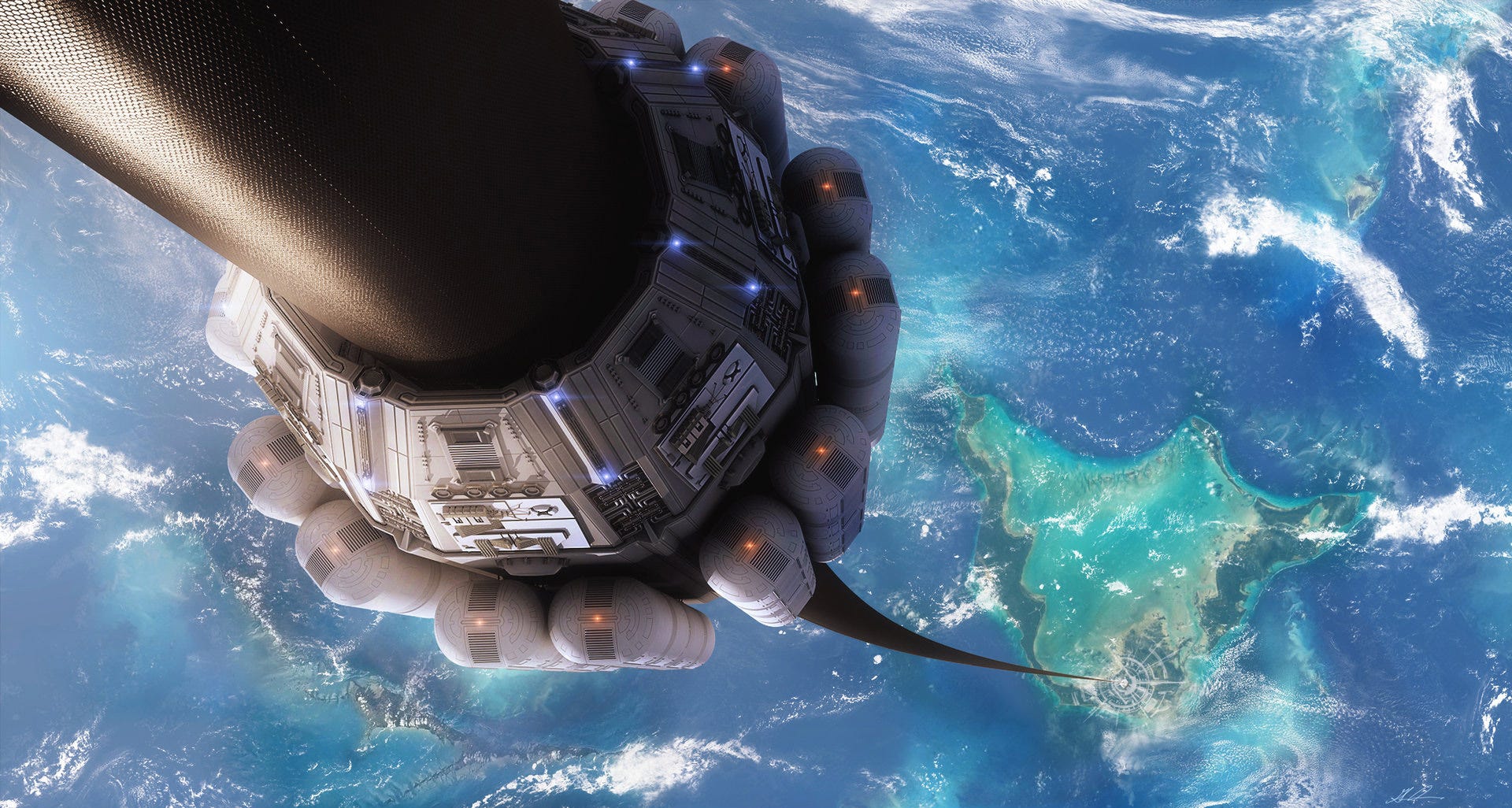
Rising Above: The Science Behind Space Elevator Tethers
The foundation of a space elevator lies in its fundamental component: the tether. This is not just a mere cable, but a giant leap in engineering and materials science. It stretches from Earth's surface to a significant altitude beyond geostationary orbit, effectively defying traditional architectural principles.
The Delicate Balance of Cosmic Forces
To keep a tether upright and functional, the forces at play must be perfectly balanced. At its core, the space elevator uses the rotation of Earth to maintain tension, similar to the way tension keeps a guitar string taut. The structure essentially leverages the centrifugal force created by Earth's rotation. An important aspect is the position of the system's center of mass at geostationary orbit. Here, the speed of orbit aligns perfectly with Earth's rotation, causing a satellite to appear stationary.
However, the extension of the tether does not stop at this orbit; it must stretch nearly 100,000 kilometers into space to maintain adequate outward pull via a counterweight. An asteroid or a dedicated station could serve as the ballast, exerting necessary centrifugal force.
Such a setup transforms the tether into a dynamically balanced structure. The force of gravity is strongest at the Earth's surface, weakening as altitude increases and centrifugal force begins to dominate. Above geostationary orbit, the tether is subject to outward forces, remaining straight due to its counterbalance in space. This balance requires the tether to be under immense tension, anchored firmly to Earth's surface rather than relying on compression like conventional towers.
The Quest for the Ultimate Material
A significant challenge in the development of space elevators is crafting a material for the tether capable of handling its own weight over an immense length. Traditional construction materials quickly reveal their limitations, being far too heavy or weak. The idea of crafting such a tether revolves around identifying a material with high specific strength—light yet robust.
Current developments in nanotechnology, especially in carbon-based materials like carbon nanotubes, present promising solutions. These nanotubes consist of carbon atoms arranged in a specific hexagonal lattice, offering theoretical strength that outstrips steel by a significant margin.
The scaling challenge prevails, however. Presently, manufacturing these nanotubes in continuous lengths necessary for a space elevator is beyond our reach, confined to short, defect-free segments. Scientists focus on innovative processing techniques to weave or fuse these segments into a systemic network, creating a ribbon strong enough to support futuristic space endeavors.
Navigating the Climb and Environmental Hazards
For the space elevator to operate meaningfully, designing climbers—or the actual "elevators"—is crucial. These climbers must be versatile, carrying their mechanism to ascend the tether without external pulling mechanisms. Their journey could span several days due to the long distance to geostationary orbit, emphasizing the need for lightweight, efficient designs.
Power supply remains a core challenge. Traditional energy sources like batteries or fuel add substantial weight, making payload objectives far less feasible. Engineers and scientists are leaning towards wireless power transmission innovations, such as directed energy from ground-based lasers or microwave beams, which energizes photovoltaic cells on the climbers for propulsion.
Moreover, the environmental trajectory from Earth's surface to orbit comprises numerous perils. Atmospheric disturbances include high winds and lighting, often requiring stationary base stations to adapt or mobilize, dodging storm systems. Beyond these, atomic oxygen could potentially corrode materials, while radiation belts threaten their electronics.
Thus, designing climbers and tethers that are adaptable, lightweight, and able to withstand a hostile journey while ensuring longevity and reliability is pivotal to realizing the space elevator concept.
From Lab to Sky: Innovations in Elevator Materials
Transitioning revolutionary materials from the laboratory to practical applications in a space elevator involves numerous experimental progressions. The process not only centers on discovering materials but refining their utility under the strenuous conditions of near-Earth environments.
Redefining Strength: The Era of Advanced Composites and Alloys
Innovators have recognized the immense potential of lightweight composites that can withstand dynamic stresses while optimizing their strength-to-weight ratios. Carbon fiber reinforced polymers and titanium alloys represent a fraction of the innovation reshaping this sector.
Unique carbon weaves, such as SpiralTwill, enhance stress distribution, providing the necessary specific strength for space elevator cables. The ability of 3D-formed titanium alloys to produce structurally efficient but minimal designs supports the rigid components essential for climber mechanisms and anchors.
Light as a Feather, Strong as Steel: The Nanomaterial Frontier
Nanotechnology affords materials revolutionary properties, like the ultralight absorbers enabled by photonic lift-off techniques. Such materials promise exceptional strength and minimal weight, revolutionizing the possibilities of tether material.
The economic and practical scaling of these advanced composites from laboratory-controlled environments to industry-level production defines the current challenge. As material science evolves, scientists are nearing the capability to produce the necessary composites for an active space elevator.
Robot Climbers: The Hidden Heroes of Space Elevators
Central to a space elevator system are the robotic climbers, a crucial component often overshadowed by the grandeur of the tether. These climbers embrace engineering complexities akin to making vertical trans-continental ascents with precision and resilience.
The Mechanics of Ascent and Traction
Climbers must overcome gravity while ensuring the tether remains unharmed. Precision in gripping the tether without tearing or sliding down is paramount. Designs utilizing high-friction rollers distribute loads evenly, essential for the lengthy vertical journey.
Returning to the imperative of weight reduction, climbers are built using ultra-light composites capable of functioning without compromising payload capacity. The aim is to maximize efficiency while ensuring the tether's integrity over extended ascents.
Powering the Journey to the Stars
Conventional energy supplies in the form of batteries and fuel are impractical due to their excessive mass, prompting innovations in alternative sources. Laser and microwave beamed power transmission from the ground reduce the need for heavy onboard systems, thus maximizing payload capacity.
Thermal management is an essential factor as well, as energy conversion generates significant heat that must be dissipated in the vacuum of space. Efficient radiators and control mechanisms are indispensable in preventing equipment from overheating, ensuring operational endurance.
Adaptive Control and Resilience in Harsh Environments
These climbers must reliably navigate through varying environmental conditions, requiring internal controls superior to any terrestrial equivalent. Autonomous systems and AI-driven fault detection play pivotal roles in achieving the nuanced adjustments necessary throughout the climber's ascent.
Equipped with technology to withstand radiation, thermal variations, and potential vibrational stresses on the tether, these robust climbers are not mere machinery but vital components in revolutionizing our approach to space transport.
Navigating the Challenges: Debris, Weather, and Safety Considerations
Beyond the engineering marvels, sustaining a space elevator system hinges on anticipating and adapting to numerous external challenges.
The Orbital Debris Dilemma: Tracking and Mitigation
Orbital debris poses significant risks to the tether, threatening collisions that could compromise integrity. Avoidance designs include using sensor networks and real-time tracking to adjust tether positioning and mitigate collision risks.
Physical resiliency measures also enhance durability, utilizing redundant fiber interconnects to manage impacts without full structural compromise. These combined efforts ensure that tether operations remain secure in active orbital environments.
Weathering the Storm: Atmospheric Stresses and Protection
Effectively extending through Earth's atmosphere, the tether encounters extreme weather conditions. Implementing aerodynamic designs and active systems help manage and mitigate environmental stresses such as wind shear and lightning.
Moreover, chemical treatments protect materials from atmospheric corrosion and wear, maintaining their durability. Proper grounding systems provide protective pathways against unexpected electrical discharges.
Safety Architectures and Global Governance
Safety measures are not limited to material and operational frameworks but extend to international cooperation. Establishing an aligned global structure streamlines procedures and data sharing to ensure collective safety.
Sophisticated monitoring systems further increase operational safety. They continually assess the structural health and environmental interactions, initiating protocols for potential contentions such as climber halts or tether retrieval during anomalies.
Together, these planning and investment strategies bolster the system's enduring reliability, paving the way for a shared, sustainable approach to space access.
Q&A
-
What are tethered platforms, and how do they contribute to space access?
Tethered platforms are systems that use long cables, often composed of advanced materials like carbon nanotubes, to connect objects in space. These platforms can be used for various purposes such as stabilizing satellites, conducting scientific experiments, or facilitating communication. In terms of space access, tethered platforms can serve as a means to transfer energy or momentum, potentially reducing the costs and complexities associated with launching payloads into orbit.
-
How do carbon nanotubes enhance the feasibility of constructing orbital elevators?
Carbon nanotubes are renowned for their exceptional strength-to-weight ratio and conductivity, making them ideal candidates for constructing the cable of an orbital elevator. This type of elevator would theoretically allow for efficient and cost-effective transport between Earth's surface and space. The unique properties of carbon nanotubes could provide the necessary strength and flexibility to withstand the immense forces and environmental challenges experienced in space.
-
What roles do elevator climbing robots play in the development and operation of space launch infrastructure?
Elevator climbing robots are envisioned as essential components in the construction and maintenance of orbital elevators. These robots could be designed to move along the tether, performing tasks such as inspections, repairs, and transportation of goods or passengers. Their development is crucial for the practical implementation of orbital elevators, offering a scalable and autonomous solution to manage the infrastructure.
-
In what ways can space launch infrastructure benefit from advancements in tethered platforms and elevator technologies?
Advancements in tethered platforms and elevator technologies can significantly reduce the cost and environmental impact of space launches. By providing a reusable and more energy-efficient means of reaching orbit, these technologies can decrease reliance on traditional rocket launches, which are costly and often have a significant carbon footprint. Furthermore, they can enable more frequent and flexible access to space, facilitating the growth of space-based industries and research.
-
What are the potential challenges facing the deployment of orbital elevators using current technologies?
Despite their potential, several challenges must be overcome to deploy orbital elevators. These include the development of materials that can withstand space weather conditions, the engineering of robust and safe tether systems, and the establishment of international regulations and cooperation for such large-scale projects. Additionally, addressing concerns about the financial viability and potential environmental impact on Earth's atmosphere and space traffic management is crucial for their successful implementation.