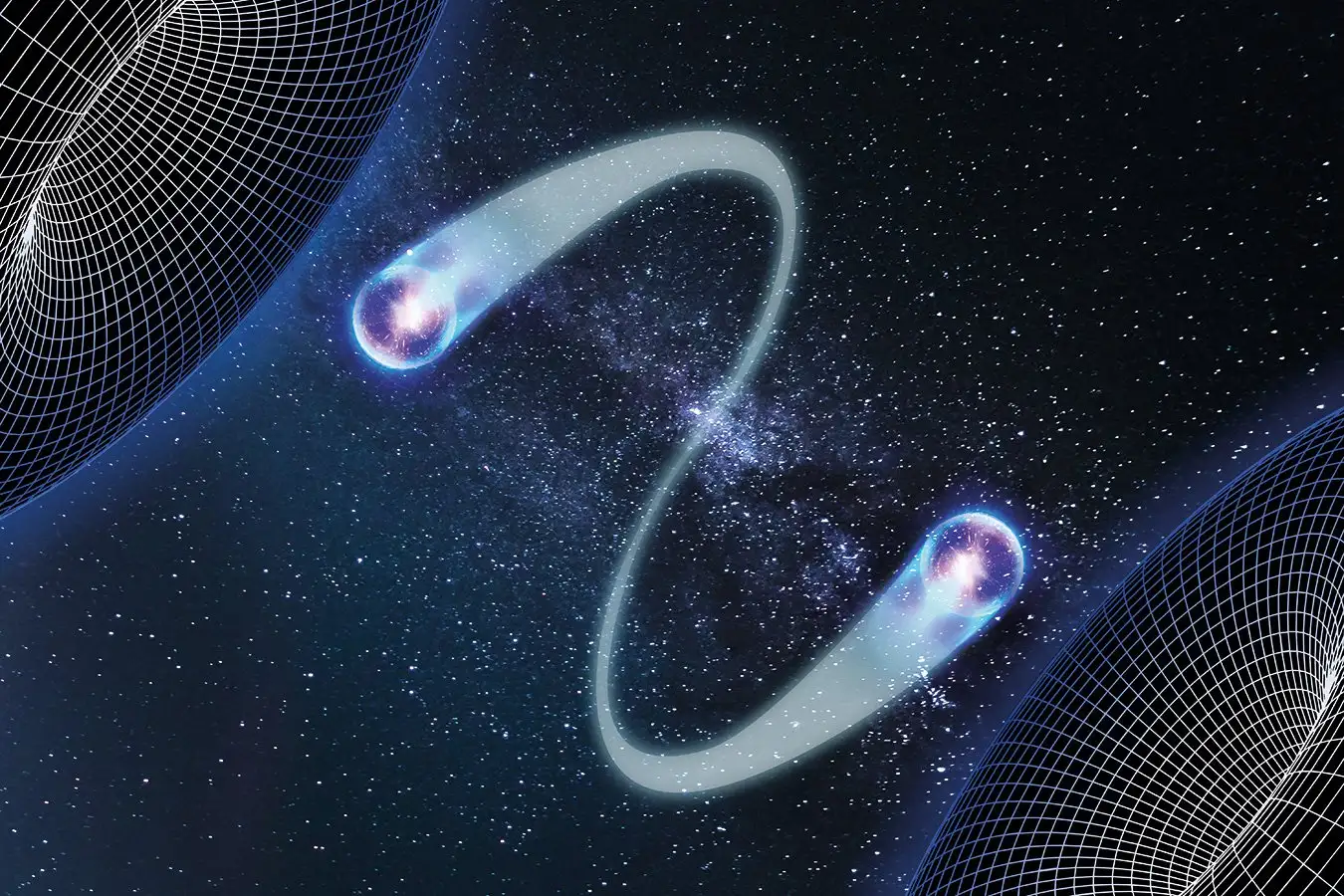
Gravitational Harmonies: Tuning into the Waves of the Universe
As we delve into the intricacies of space-time, understanding the vibrational patterns generated by the universe becomes crucial. The study of gravitational waves interlinks our perception of space with the ethereal music of the cosmos, offering profound insights into celestial events.
The Cosmic Dance of Black Holes
In the vast expanse of the universe, binary black holes spiral into each other, merging in spectacular displays. This cosmic waltz emits gravitational waves - disturbances in the fabric of space-time that travel vast distances to reach Earth. These waves offer scientists unique insights into the mass and spin of these mysterious entities, unveiling secrets of their formation and evolution. Observing the mass distribution in these collisions, scientists have found that black holes around 35 times the mass of our sun are common. This “bump” in data provides clues about their origins, hinting at the possibility of formation through interactions within star clusters where frequent collisions occur.
Notably, the spin of these celestial giants also narrates a tale of cosmic transformations. By translating data to the "source frame," researchers peer back in time, uncovering the ancient spins of these entities. Recent confirmations of the "area theorem" further enrich our understanding, affirming that the total event horizon area never decreases, corroborating Einstein's profound theories. Each observation acts like a puzzle piece, fitting into the grand narrative of cosmic dynamics, helping us refine the precision with which we map the universe’s evolution.
Gravitational Lensing: Seeing Through the Warp
While gravitational waves allow us to "hear" cosmic dances, gravitational lensing enables us to "see" the contortions within the space-time continuum. Massive celestial bodies, like black holes or galaxy clusters, bend and warp nearby light. This phenomenon acts as a natural magnifying glass, amplifying our ability to observe objects far beyond our normal reach.
Gravitational lensing has revolutionized astrophysics by allowing astronomers to detect distant galaxies as they appeared billions of years ago. Through detailed simulations that reconstruct the true appearance of these cosmic entities, scientists decipher the warped shapes and their implications on mass distribution, including dark matter concentrations. This rigorous methodological approach, involving photometric calibration and noise stripping, solidifies lensing as a cornerstone tool for space-time measurement.
Mapping the universe’s structure through these creative uses of light and gravity intertwines observation with theoretical insight. It's a dynamic dialogue - understanding of geometric distortions illuminates distant regions of space, and in turn, enhances theoretical models of matter distribution and evolution in the cosmos.
Earth’s Changing Gravity Field
The principles of space-time metrology also extend to understand our own ever-changing planet. Earth, with its shifts and flows, possesses a dynamic gravitational field in continual flux. By observing these minute changes, scientists can gauge the redistribution of mass across the planet's surface.
Through satellite altimetry, the height of oceans and landmasses is monitored with extreme precision. These advanced systems maintain measurements to within millimeters, capturing variations due to phenomena such as melting ice sheets or drought-affected aquifers. Each fluctuation reflects shifts in mass, affecting local gravity.
Documenting these fluctuations deciphers vital environmental changes, linking climate dynamics to gravitational shifts. The interconnected physics elucidates underlying shifts from gravitational consequences of hydrological changes. By marrying terrestrial processes to unfurling cosmic events, we unlock deeper insights into fundamental physical laws that govern both our planet and the universe. This knowledge aligns gravity’s silent influence with the observable universe, binding cosmic and earthly queries into a cohesive understanding.
Precision Listening: The Evolution of Detection
The advanced detection of gravitational waves signifies a profound leap in our observational capability, a leap that demands remarkable precision. Interferometers, the instruments designed to sense these minute ripples, span kilometers and must be attuned to the slightest distortions—down to a fraction of a proton’s width.
Current technology has evolved past initial detection into an era of refined observation. Modern detectors isolate signals from terrestrial noise, fortifying their sensitivity amid environmental vibrations by using advanced noise reduction and feedback systems. Every refinement brings clarity to the cosmic orchestra, translating the patterns within gravitational waves to substantive insights about celestial phenomena.
This quest for precision extends metrology’s boundaries and verifies aspects of General Relativity. Enhanced accuracy enables tests of gravitational models against empirical waveforms, teasing potential new physics buried in noise. These fine-tuned signals elevate gravitational metrology from a theoretical pursuit to a rigorous discipline, rooted in the fabric of practical physical research, blending cutting-edge technology with profound theoretical curiosities.
Quantum Leap: Standards That Transform Time and Space Navigation
Embarking on transformative upgrades in measurement standards, quantum dynamics unlocks unprecedented intricacies of space-time navigation and metrology. Precision timekeeping lies at the heart of this paradigm shift, ensuring deeply synchronized and accurate global systems.
The Symphony of Atoms: Cavities and Arrays
The underlying drive to redefine time standards aligns with cutting-edge quantum mechanics, beginning with atomic arrays. Traditional atomic clocks have maximized precision by leveraging the natural oscillation frequencies of atoms. However, these clocks faced constraints from the inherent uncertainties of atom behavior at the quantum level.
Innovations involving atomic cavities demonstrate synchronization by creating entangled states within cavity structures, reducing measurement noise significantly. An orchestrated correlation of atoms produces a more refined signal for accuracy, akin to a perfectly synchronized choir of voices creating harmony. This correlated atomic behavior forms the foundation for achieving a standard far surpassing the boundaries encountered by previous methods.
Through ingenuous engineering design, atomic cavities harness the power of entanglement and spin squeezing, building hybrid models that couple different types of quantum memories. These advancements herald a new era of clocks, theoretically immune to classical drift and redundancies, effectively pushing the envelope of metrological reliability.
The Energy of Time: Electron Jumps and New Definitions
Exploring the relationship between energy and time unveils fascinating dimensions in our definition of fundamental time units. Techniques like single-electron jump clocks probe this relationship, analyzing the cost of electron transitions in energy states on an elemental level.
Identifying the energetic dynamics of these transitions simplifies understanding of time’s intrinsic dimensions. A more accurate definition of the "second" incorporates results from these energy-focused studies, transcending the limitations of older cesium-based time standards. These “quantum jumps” toward new metric definitions pave the way to unprecedented navigational precision by ensuring any reference of time remains tightly aligned with universal constants, unshackled by geographical deviations or energy discrepancies.
Moreover, sensitive electron-transition detection technologies can identify even minor changes in altitude by recording time variations due to gravitation. Emerging as innovative geodesic sensors, these ultra-precise clocks map gravitational fields and further enrich self-contained navigation methods through careful gravitational acuity.
Global Infrastructure and the Environmental Imperative
The catalysts driving developments in metrology extend beyond theoretical breakthroughs. As climate challenges expand, demands for environmental vigilance and precision grow. Enhanced time and space measurement underpin robust frameworks for monitoring dynamic changes in sea levels, climate indicators, and atmospheric constituents on a planetary scale.
Quantum advancements dovetail into environmental monitoring technologies. Leverage of high-precision quantum clocks assists researchers in crafting dynamic climate models, ensuring that understanding of natural phenomena is aligned with observational science. Enhanced precision mapping assists environmental policy frameworks across global infrastructures, pre-emptively addressing anticipated challenges through precise, well-timed insights.
Harmonizing quantum developments across the environmental landscape underscores global motivation toward unifying science and technology. Establishing future-forward instruments harmonizing the world’s time and environmental science creates continuity throughout global projects. Unprecedented clarity in synchronizing observational insights collects scattered data into comprehensive syntheses, bridging emergent environmental patterns with actionable solutions.
Innovative Landscapes: Charting the Future of Space-Time Metrology
Arguably, the future of measurement rests upon innovations reaching beyond traditional applications, driven by aspirations interfacing with interconnected networks and decentralized performances. Orchestrating this evolution requires custom approaches grounded in practical utility and profound scientific advancement.
The Orbital Mesh: A New Era of Connectivity
Satellite networks high above Earth represent a transformative path for future metrology systems. Historically sparse, these networks evolve into complex, interconnected constellations offering redundancy and continuity, significantly enhancing global measurement systems resilience.
The transition to dense satellite networks allows for expanded data sources and decentralized information throughput. Conventional dependency on centralized infrastructures reduces, creating robust oversight over metrological data, enabling new service systems impervious to localized technology failures.
Developing innovative satellite networks operating synergistically promotes the democratization of metrological capabilities. Dispersing fine-grained sensing hubs strengthens public access to navigational precision, transcending traditional barriers of accessibility and inclusivity. This transformation into an omnipresent infrastructure unfolds a dynamic epoch where fundamental space-time principles are integrated seamlessly within societal frameworks, ensuring future planetary navigation and synchronization are enriched by these sophisticated mechanisms.
Decentralization and Efficiency: Processing at the Edge
Concurrent advancements in computational paradigms exemplify key shifts in real-time processing locationization strategies. Transferring processes from cloud cores towards distributed edge structures underlines this evolution by optimizing data throughput efficiency.
Smarter, localized data processing expels limitations of latency and remains cost-effective while fulfilling emergent data requirements. Local computational capacities excel in supporting immediate results over collective systemic reliance, preserving real-time insight integrity within user applications and extending the efficiency of metrological practices throughout broader markets.
Striking an optimal balance between distributed localized computing capabilities and overarching data ecosystems emerges crucial. Amplifying end-user connectivity projects intelligent depth processing upon personal device capabilities, providing rich insights accessible equitably across diverse users.
The Pulse of the Planet: Metrology for Earth Science
Integration of meticulously calibrated time instruments in earth-science arenas constitutes reformative metrological advancement. Space-time metrology enhances environmental observation strategies by investing insightful precision into evolving global temporal maps, translating "when" and "where" into actionable interventional insights.
Recent advancements revolutionize comprehension of planetary dynamics, transcending technological boundaries cultivating harmony between technology and nature. Precision in geophysical measurements revisits the dimensions of terrestrial transformations, intimately associating dynamic spatial change responsiveness with general earth observation principles.
Precision methodologies dovetail seamlessly into feedback mechanics relating to climactic oscillations, refining scientific expectations through unprecedented insights. Harnessing disruptive yet ethical technology solutions defines contours of pancreatic responses contrary to wider environment conditions, achieving breakthroughs integral to responsible policy development processes.
Q&A
-
What is the importance of precision time measurement in modern technology?
Precision time measurement is crucial in modern technology as it enables high accuracy in various applications such as GPS navigation, telecommunications, and financial transactions. It ensures synchronization across systems, which is vital for data integrity and operational efficiency.
-
How does the space-time continuum relate to navigation technologies?
The space-time continuum is a fundamental concept in physics that describes the four-dimensional fabric of the universe. In navigation technologies, understanding this concept allows for the development of more accurate positioning systems by accounting for the effects of relativity, which can influence the timing and accuracy of signals used in GPS and other location-based services.
-
What role does gravitational wave detection play in advancing our understanding of the universe?
Gravitational wave detection provides a new way of observing cosmic events, allowing scientists to study phenomena such as black hole mergers and neutron star collisions. This enhances our understanding of the universe's structure and dynamics, and helps verify predictions made by Einstein's theory of general relativity.
-
How are quantum time standards different from traditional timekeeping methods?
Quantum time standards utilize the properties of quantum mechanics to achieve unprecedented levels of accuracy and stability in timekeeping. Unlike traditional atomic clocks, which rely on microwave transitions, quantum clocks can use optical transitions that offer higher frequencies and therefore greater precision, pushing the boundaries of time measurement.
-
In what ways does relativity in technology impact everyday devices?
Relativity in technology impacts everyday devices by ensuring their proper function, especially in systems that rely on precise timing, such as GPS. The theory of relativity predicts that time runs slightly differently depending on gravitational fields and relative motion, so adjustments based on relativity are necessary to maintain the accuracy of these systems.