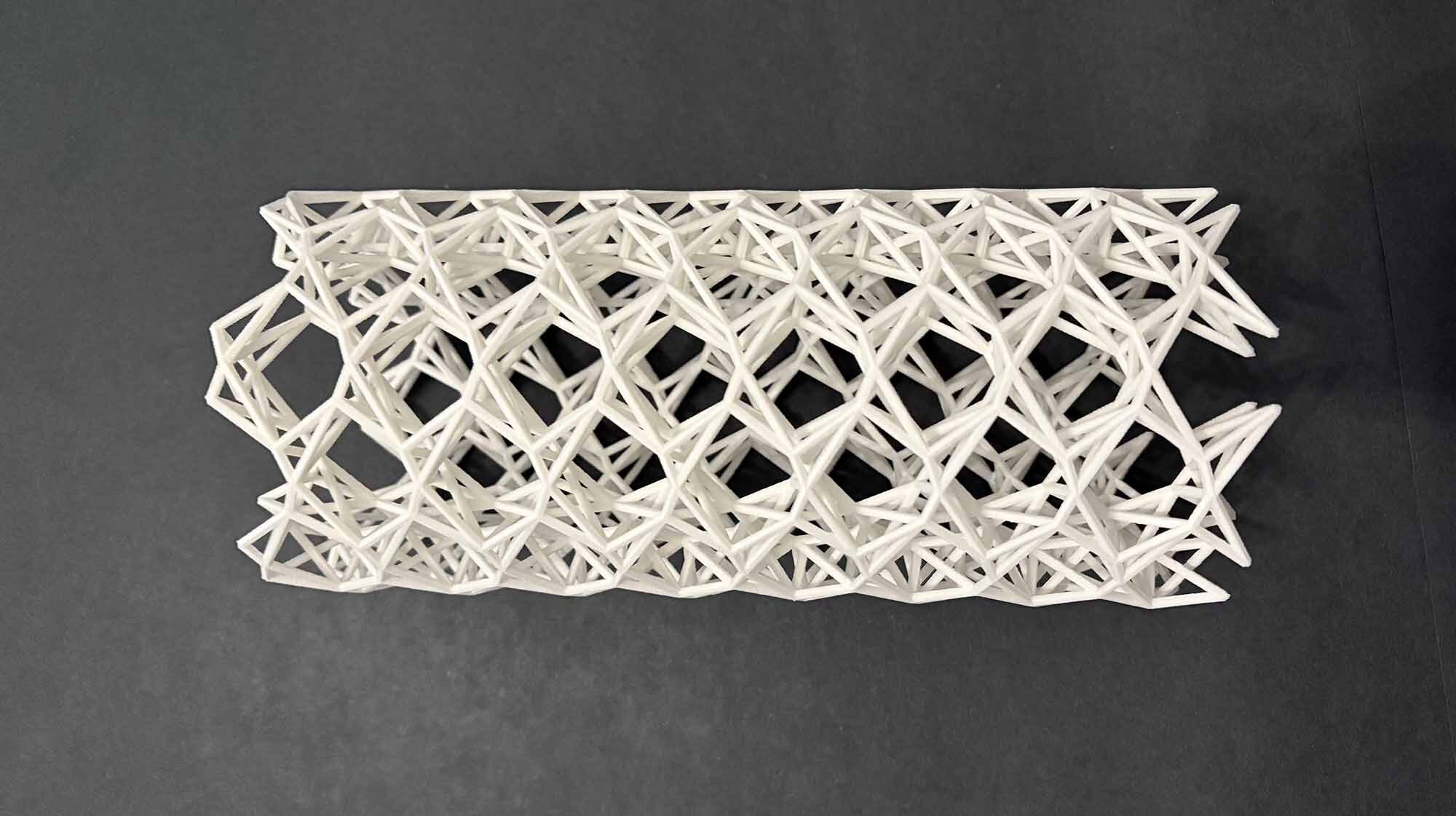
Exploring the Essential Properties of Innovative Materials
The creation of materials that interact with various forms of energy, bending and redirecting waves such as sound and light, marks a significant departure from traditional physics. Unlike materials whose behaviors are dictated by their atomic structure, these innovative substances manipulate the geometry of their internal structure to produce new capabilities.
1. The Complexity of Negative Index Constructs
The exploration of materials with properties previously thought impossible is fundamentally altering wave propagation. Negative index materials are central to this change, with properties allowing electromagnetic waves to bend in unconventional ways, unlocking new potential for technological applications.
Negative index materials possess the unique capability where their refractive index is tuned to be negative. This revolutionary property changes how waves propagate, offering ways to achieve effects such as perfect lensing, where objects appear clearer than what conventional physics allows. The phenomenon of negative refraction can potentially revolutionize industries reliant on wave propagation, such as telecommunications and imaging.
In these materials, wave paths can be altered to create coatings that absorb electromagnetic waves and turn objects invisible. This characteristic drives applications in stealth technology, where invisibility to radar systems becomes a technological reality. Notably, researchers in the United States have delved deep into these negative index constructs, focusing on understanding their wave propagation abilities and the underlying physics that make their behaviors possible.
2. Resonance in Sound Management Systems
Acoustic metamaterials offer groundbreaking advancements in sound wave control. By engineering internal structures at micro scales, these materials can manipulate sound in ways that defy long-held acoustic principles. This includes the creation of sophisticated noise-cancelling devices and the improvement of imaging technology.
The United Kingdom has been at the forefront of acoustic metamaterial research, focusing on creating intricate designs that control sound propagation more effectively. These designs help in achieving acoustic bandgaps—ranges of sound frequencies that can be completely blocked by these materials—enabling highly efficient noise reduction solutions.
Such innovations may pave the way for improvements in a variety of fields, from architectural acoustics to medical imaging. Researchers are using these capabilities to develop materials that can guide sound waves around objects seamlessly—likewise enabling objects to become “invisible” to sonar technology. This could lead to significant advancements not only in stealth operations but also in constructing quieter, more controlled environments in urban settings.
3. Cloaking Advancements and Their Mechanisms
Human fascination with invisibility extends into the scientific community, where cloaking devices have moved beyond mere fantasy into actionable research avenues. By manipulating electromagnetic waves, metamaterials have crafted cloaks that make objects appear invisible—a groundbreaking scientific endeavor with roots in the precise control of wave behaviors.
In Australia, studies of metamaterial cloaks are revealing the mechanics of how to render objects invisible to electromagnetic detectors. This involves creating materials capable of bending waves around an object, such that they re-emerge on the other side as though uninterrupted, leaving no detectable shadow or reflection.
The focus lies on understanding the delicate interplay between wave behavior and the engineered structure of these cloaks. These innovations not only promise transformations in camouflage technology for both civilian and military applications but also open doors to future applications in privacy technologies and secure communication systems. As the cloaking research progresses, it contributes to a rapidly evolving field that stretches across optical physics and materials science.
Dynamic Shifts in Technology: Programmable Materials
The next frontier involves materials that do not merely maintain static properties but exhibit dynamic adaptability to environmental changes. This evolution in material science emphasizes responsiveness and programmability, marking a shift toward more dynamic, autonomous systems with a wide range of applications.
1. Kirigami and Structures in Motion
Borrowing concepts from the traditional art of paper cutting, researchers are finding innovative ways to enhance the mechanical properties of materials. This approach offers new possibilities for dynamic wave management and structural responses through materials that change shape or stiffness automatically based on environmental stimuli.
The technique involves creating kirigami-inspired structures, where strategic cuts and folds allow for dynamic deformation under stress. These materials don't simply get thinner when stretched but can alter their physical state to adapt to varying conditions. This aspect of tunable mechanical properties holds promise for enhancing structures such as buildings or vehicles to respond and adapt to stresses like wind loads or vibrations actively.
By enabling materials to change their configuration in real-time, engineers can guide mechanical wave energies along preferred pathways, providing protection to sensitive structures from environmental vibrations. This revelation transforms static construction materials into versatile adaptive elements that greatly enhance resilience and energy efficiency in structural design.
2. Manipulating Electromagnetism with Precision
The capacity to control electromagnetic waves through metamaterials stands at the cusp of engineering advancements, allowing precision manipulation in telecommunications and energy systems. By engineering surfaces with programmable properties, new methods for enhancing signal transmission and reception are being explored.
Researchers are developing metasurfaces embedded with arrays of tunable "meta-atoms," microscopic structures acting like antennas, which can adjust their behavior in response to electromagnetic waves. This engineering feat enables precise beam steering and control over electromagnetic wavefront, a necessity for future communication systems looking to manage bandwidth in increasingly congested environments.
Such innovations offer directions to create shielded environments or guide waves to specific targets, significantly expanding capabilities in both civilian and commercial applications. With the increased complexity of global telemetry systems, these technologies provide the adaptability necessary to secure and optimize data transmission in densely populated regions.
3. Sensing the Environment and Responsive Adaptation
The transition to intelligent materials represents a convergence of sensing, logic, and actuation functionalities, creating systems that autonomously adjust to environmental stimuli. These materials promise revolutionary shifts in how structures interact with their immediate spaces, optimizing their performance based on real-time data.
Incorporating sensors and actuators into fabric structures enables metamaterials to adapt their properties dynamically. For instance, in architectural design, a wall could modify its acoustic properties instantly to enhance sound distribution, or on a concert stage, a floor could transition to vibrate at specific frequencies for effect.
In practical examination, if a radar is detected, a surrounding cloak could variably adjust its properties to effectively dampen its signal. This enhances the potential for stealth technologies, enabling seamless integration into complex systems with real-time adaptability. The active engagement of these innovative materials with their surroundings heralds a future where response and efficiency are integral, continuously maximizing both functionality and flexibility without human intervention.
Converging Fields: Future Horizons of Advanced Materials
The bridging of metamaterials with quantum and other cutting-edge technologies opens new horizons, extending possibilities into realms beyond traditional physical limitations. Researchers are pushing the boundaries, crafting devices that harness quantum mechanics and light-based processing for unprecedented control over energy and information.
1. Quantum Sensing with Advanced Constructs
Metamaterials in quantum science integrate engineered structures to enhance quantum devices' sensitivity beyond classical capacities. Quantum leaps in sensing, driven by engineered diamond systems and entangled spin networks, represent breakthroughs in capturing minute environmental variables at atomic scales.
Studies involving engineered diamonds hosting quantum spins exhibit entanglement properties enabling high-precision sensing. This leap enhances measurement sensitivity, reducing uncertainty down to levels below classical thresholds through quantum squeezing—a technique that sharpens detection accuracy beyond conventional limits.
These advancements offer substantial improvements for sensors, essential in fields that require extreme precision like medical diagnostics or environmental monitoring. The application of metamaterials in quantum technology forecasts significant progress in developing devices that can gather unparalleled information about physical and biological systems.
2. Pushing Optical Boundaries for Novel Solutions
Simultaneously, optical advances in metamaterials redefine how we perceive and utilize light. Evolving exploration beyond visible spectra fosters new opportunities for imaging, energy management, and wave manipulation, significantly enhancing technology's capacity to operate at the quantum level.
Epsilon-near-zero (ENZ) materials illustrate this promise, allowing electromagnetic waves to extend seemingly without bounds within a material, facilitating nearly lossless propagation. This characteristic is pivotal for developing high-frequency components essential to wireless communication advancements and ground-breaking imaging technologies.
Furthermore, hyper-materials in optics, such as super-lenses, use negative refraction properties to see smaller structures with greater detail. These super-lenses capture evanescent waves and resolve objects beyond diffraction limits, presenting untapped capabilities in medical imaging and surveillance systems.
3. Thermal Management and Multi-functional Interfaces
Combining materials science with thermal physics offers new methods for controlling heat and radiation at once, presenting integrated systems with dual functionalities. Hybrid materials crafted for precision thermal and light control ensure elements function smoothly even under extreme conditions.
Innovations create scenarios where materials, reflective in visible light yet emissive in the infrared spectrum, can maintain optimal temperatures through passive radiation management. This principle extends to stealth, where metamaterials can be used to manage heat signatures passively while maintaining invisibility in visible and radio wavelengths.
These multi-functional interfaces point towards a future where energy-efficient systems integrate seamlessly across disciplines, supporting sustainability goals and elevating the operational standards of both civilian and military technologies globally.
As researchers advance further, these cutting-edge technologies promise to redefine the boundaries of human achievement, with metamaterials playing a pivotal role in revealing and controlling the fundamental behaviors of waves in ways that profoundly reshape both our technological landscape and natural understanding.
Q&A
-
What are Negative Index Materials and how are they used in technology?
Negative Index Materials (NIMs) are artificial structures that have a negative refractive index. This unique property allows them to bend light in the opposite direction compared to conventional materials. NIMs are used in developing superlenses that surpass the diffraction limit of conventional lenses, potentially revolutionizing imaging technologies in fields such as microscopy and lithography.
-
How do Acoustic Metamaterials contribute to sound manipulation?
Acoustic Metamaterials are engineered to control, direct, and manipulate sound waves in ways not possible with natural materials. They are used to create soundproofing systems, enhance sound quality in auditoriums, and develop novel devices like acoustic cloaks, which can make objects acoustically invisible by guiding sound waves around them.
-
What advancements have Electromagnetic Metamaterials brought to communication technology?
Electromagnetic Metamaterials have significantly impacted communication technology by improving antenna performance and enabling the development of compact, highly efficient devices. They facilitate better signal control and can lead to the creation of more reliable and faster communication systems, supporting advancements in wireless technology and satellite communications.
-
In what ways do Optical Metamaterials enhance light manipulation?
Optical Metamaterials are designed to manipulate electromagnetic waves at optical frequencies. They have applications in creating invisibility cloaks that render objects undetectable to the human eye, developing more efficient solar panels by improving light absorption, and enhancing the performance of optical devices such as lasers and sensors.
-
How are Programmable Metamaterials changing the future of material science?
Programmable Metamaterials are dynamic structures whose properties can be altered in real-time through external stimuli, such as electrical signals. They offer versatility in applications like adaptive lenses, tunable filters, and reconfigurable antennas. This adaptability is paving the way for smart materials that can change their characteristics on demand, opening new possibilities in various technological fields.