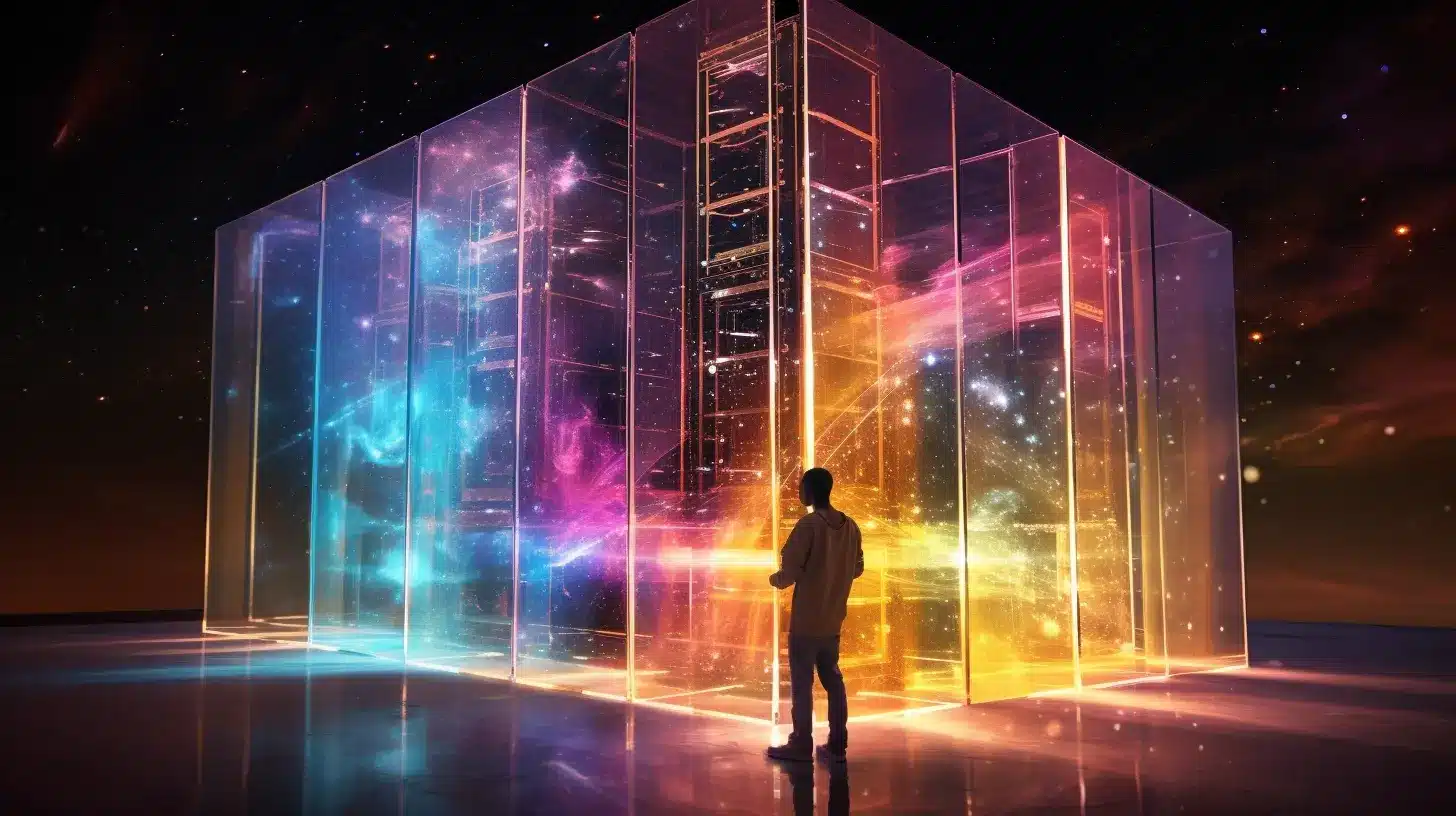
Unpacking the Magic: How Advanced Storage Systems Operate
The transition from conventional data storage methods to systems that leverage light for volumetric data storage marks a significant breakthrough. This shift moves beyond surface-level data inscription, embracing three-dimensional encoding and retrieval that could redefine capacity capabilities.
The Leap from Surface to Volume in Digital Memory
Traditional data storage systems have relied on two-dimensional surfaces to capture and retain information, akin to organizing items on a conveyor belt. This approach includes magnetic and optical technologies, which depend on sequential data arrangement. However, this method limits the volume of data that can be stored and speed at which it can be accessed.
In contrast, holographic memory utilizes the entire volume of the recording medium. This is similar to expanding storage capacity by constructing a high-rise building instead of merely extending a single-story structure. By using a special photopolymer or crystal, data is suspended throughout the material’s volume, enabling unprecedented storage expansion and accessibility.
The concept of multiplexing plays a crucial role here. By altering the angle or wavelength of the laser beams used to write data, multiple layers of information — referred to as “pages” — can be imprinted into a single space, significantly increasing storage density. This innovation ensures that massive amounts of data occupy minimal physical space.
The Dance of Light: Writing and Reading with Precision
At the heart of this new technology is the use of lasers and light interference. Unlike simple laser burning in CDs, holographic storage employs coherent light beams to create complex interference patterns. This method uses two laser beams: the signal beam that carries data, and a reference beam that serves as a benchmark for reading the data.
When these beams intersect within the storage medium, they create an interference pattern that encodes the data in three dimensions. The interaction of light with the photosensitive material results in changes to its refractive index, effectively "printing" a 3D picture, or hologram, of the data within the material.
Retrieving this data is equally advanced. By directing the reference beam back into the storage medium at the exact angle used during data inscription, the interference pattern is reconstructed, allowing information to be accessed as if an entire page were read simultaneously. This parallel data retrieval dramatically accelerates data access speeds, making the technology suitable for environments requiring rapid data access.
From Theory to Reality: Recent Material and Technology Innovations
As engineers and scientists push the boundaries of what's possible with light-based storage, substantial progress has been made to transition from theoretical concepts to practical devices capable of revolutionizing data retention.
Breakthroughs in Photonic Materials
Significant advancements in photonic materials have paved the way for practical holographic storage solutions. For holography to function, the materials must be photosensitive and stable, capturing light interference patterns accurately and preserving them without degradation over time.
Materials such as low-power photorefractive polymers are now in focus due to their ability to respond to light and manage chemical changes required for 3D data recording. These materials provide a dynamic canvas onto which data can be written and rewritten, while also supporting data longevity by resisting environmental factors like temperature and humidity variations.
The development of metasurfaces has also played an essential role. Unlike traditional optical lenses, metasurfaces leverage microscopic structures to control wavelengths with precision, ensuring data is recorded and retrieved accurately. These innovations are crucial for developing compact, stable, and efficient holographic systems.
Mastering Multiplexing for High Data Volumes
The concept of multiplexing has been refined to boost data capacity. By altering the phase, angle, or wavelength, multiple data sets coexist, occupying the same physical space within the recording medium. This method allows for exceptional data density, leveraging the volumetric nature of holographic media.
Current prototypes demonstrate that high-density storage can reach levels previously deemed unfeasible with conventional magnetic or optical drives. This advancement is particularly appealing for industries that manage large volumes of data, knowing that each instance of data storage is optimized to use minimal physical space.
Combining these multiplexing strategies with cutting-edge coding algorithms mitigates issues like crosstalk and signal interference, ensuring that data remains distinct and retrievable with clarity. The parallel processing capability fundamentally enhances retrieval speeds, establishing holographic technology as the ideal solution for fast-paced, data-intensive environments.
Integrating Systems to Expand Adoption
The potential of holographic storage depends heavily on successful integration into conventional ecosystems. With cutting-edge developments in semiconductor packaging, it's possible to hybridize electronic and optical components, enabling the seamless exchange of signals.
Recent strides in semiconductor stacking and bonding techniques have led to advanced packaging solutions that support efficient data handling. By reducing the physical distance required for data travel, these innovations significantly enhance bandwidth, aligning with the speed and capacity of holographic storage devices.
Cooling solutions and thermal management are paramount for these systems. Integrating thermal interface materials and cooling pathways ensures the optical components operate under stable conditions, preserving data integrity. This holistic approach ensures that advanced storage systems can function effectively in various commercial settings.
Discovering Key Materials: Integration of Photopolymers and Quantum Crystals
Behind the scenes of this technological leap are the materials driving it forward. Understanding the features of photopolymers and quantum crystals is essential to appreciating how these technologies are deployed effectively.
Photopolymers: Harnessing Flexibility for Enhanced Recording
Photopolymers exhibit a level of adaptability unrivaled in other storage mediums. These materials react dynamically with light to alter their refractive index — a property vital for recording and encoding information volumetrically.
Recent breakthroughs highlight formulations that improve the dynamic range of these materials, enabling finer modulations of light and enhancing storage capacity. Photopolymers can thus hold terabytes of data securely, lending themselves well to environments where physical space is limited but storage needs are vast.
Moreover, advancements in polymer chemistry have stabilized these materials post-recording, ensuring the fidelity of stored data over extended periods. This stability is crucial for archival purposes, where data must remain accessible and accurate over decades. The ability to customize polymer compositions means that photopolymers can be tailored for specific needs, from high-sensitivity applications to long-term stability solutions.
Quantum Crystals: Nonlinear Optical Properties
Quantum crystals are emerging as the go-to materials for performance-intensive storage systems due to their unique optical properties. These crystals, like lithium niobate, have rigid structures that allow for detailed data encoding and retrieval without fidelity loss.
The nonlinearity of these materials enhances their capacity to process intense data volumes quickly. Their ability to store, erase, and rewrite data repeatedly adds to their versatility, making them suitable for applications where data agility is prized.
In addition, quantum crystals support innovative applications like quantum holography. This technology offers security advantages, leveraging quantum states to prevent tampering and unauthorized access. The intrinsic stiffness and transparency of quantum crystals also mean they are less susceptible to environmental degradation, ensuring long-term data authenticity.
The Potential of Hybrid Systems
Hybrid systems represent an exciting fusion of photopolymers and quantum crystals, combining their respective strengths to mitigate challenges each material faces separately. Photopolymers contribute high density and versatility, while quantum crystals provide optical precision and rewriteability.
These systems address speed limitations by optimizing both read and write cycles, allowing rapid data processing. Incorporating crystalline nanoparticles within the polymer matrix improves stability, ensuring that data remains accurate and accessible despite potential material shrinkage.
Material processing techniques for these hybrids are advancing, making scalability a realistic goal. Development methods are being refined to ensure uniformity and reduce error rates, providing strong foundations for high-capability data storage solutions. As these hybrid approaches evolve, they promise to redefine the architecture of modern data storage, marrying the best of what polymers and crystals offer.
Beyond Conventional Discs: Unleashing Holographic Technologies
The potential of holographic storage becomes even more pronounced when compared to current technologies, like Blu-ray, that are limited by physical dimensions.
Breaking the Two-Dimensional Barrier
Traditional Blu-ray discs, while impressive, are ultimately limited by their design, centering around a single or double layered structure. Holographic discs introduce a new paradigm by leveraging volumetric data encoding, exceeding the capabilities of typical discs by storing information in the full depth of the medium.
The process of data writing and retrieval in holographic discs is akin to projecting a multi-tiered light show inside the material. By splitting a single laser into two beams, an interference pattern forms within the disc, capturing data as holograms. These holograms share the same space, elevating storage density beyond the scope of Blu-ray technology.
Setting a New Standard for Speed and Capacity
Holographic storage achieves a storage capacity that conventional discs cannot match, with potential reaches into multiple terabytes per unit. This ample capacity is invaluable in an era where high-definition and immersive content dominate industries.
Speed, too, signifies a crucial advantage. As opposed to reading sequential bits, holographic systems access entire pages of information in a single moment through laser light projection, matching modern demands for high-speed data processing efficiently.
Applications that necessitate rapid access to massive amounts of data, such as media production or scientific exploration, stand to benefit greatly from these advancements. The convergence of high density and speed assures reliable information flow, outperforming the sequential nature of existing systems.
Durability and Long-Term Storage Solutions
With longevity as a key consideration, holographic discs offer noteworthy durability. Recent chemical advancements have birthed polymers resistant to degradation and wear, making them ideal for long-term data preservation.
Holographic data is not as vulnerable to damage, as data is stored within the bulk of the disc rather than merely on its surface. Scratches or surface imperfections, which could devastate standard optical discs, are less impactful here. This internal storage allows for robust error correction, preserving the integrity of stored data over time.
Institutes needing to archive cultural artifacts or pivotal records will find lasting utility in holographic discs, enjoying sustained data access without constant renewal or hardware migration.
Focus on Innovation for Widespread Use
Historically, holographic storage has faced technological and economic barriers preventing widespread adoption. However, developments in precision laser manufacturing and system miniaturization mean the technology is transitioning out of labs and into potential mainstream commerce.
Innovations improving optical system reliability, reducing manufacturing complexity, and aligning materials science processes with scalable production are achieving cost reductions and expanding market possibilities. Companies committed to these enhancements aim to make holographic storage a viable, next-gen solution for both enterprise and home use as further progress unfolds.
Q&A
-
What is 3D Data Storage and how does it differ from traditional storage methods?
3D Data Storage refers to the method of storing data in a three-dimensional space, allowing for significantly higher data density compared to traditional two-dimensional storage media. Unlike traditional hard drives that store data on flat surfaces, 3D data storage utilizes the volume of the storage medium, potentially increasing capacity and speed by orders of magnitude.
-
How does Holographic Memory function and what are its advantages?
Holographic Memory uses the principles of holography to store data in a volumetric form, recording data throughout the volume of the storage medium rather than just on its surface. This technology allows for parallel data processing, potentially offering faster data retrieval speeds and greater storage capacities compared to conventional memory systems.
-
Can you explain the role of Optical Storage Systems in modern data storage solutions?
Optical Storage Systems use light to read and write data. They include technologies such as CDs, DVDs, and Blu-ray discs. These systems are known for their durability and portability, making them suitable for data archiving and distribution. Advances in optical storage, like holographic discs, aim to further increase storage capacity and speed by leveraging three-dimensional storage techniques.
-
What is Quantum Holography and how might it impact future data storage technologies?
Quantum Holography involves the use of quantum properties of light to create and interpret holograms, potentially leading to extremely high-density data storage solutions. By utilizing quantum mechanics, this technology could revolutionize data storage, offering secure, efficient, and massively parallel data processing capabilities that far exceed current limitations.
-
In what ways does Data Encoding with Light enhance data storage technologies?
Data Encoding with Light involves using light waves to encode information, which can then be stored in optical media. This method enhances data storage by allowing for high-speed data writing and reading, as well as increasing the potential storage density. Light-based encoding is crucial for developing advanced storage systems like holographic discs, which aim to surpass the capacities of traditional storage solutions.